info@innovativecleaning.co.uk

0808 280 2662

COSHH in Commercial Cleaning What UK Businesses Must Know

Understand COSHH in commercial cleaning, your legal responsibilities and how to safely manage hazardous substances to protect staff and maintain compliance.

Commercial cleaning often relies on harsh chemicals, regardless of whether you are cleaning an office or a massive warehouse. The difference lies in the concentration required: small offices need fewer or milder products, whereas warehouses and factories require harsher chemicals. However, negligence in any setting can have catastrophic consequences. This is why proper workplace safety management is essential.

Although COSHH can feel difficult at first, particularly when Safety Data Sheets contain technical language, it offers a clear inventory, practical risk assessments, safe working procedures and training records that reflect how cleaning is carried out on site.

COSHH compliance is an essential part of maintaining a safe and hygienic workplace. Reputable cleaning services in Birmingham implement strict procedures to reduce risks and help businesses meet UK health and safety standards.

What Is COSHH for Cleaning Chemicals and Why Does It Matter?

COSHH stands for the Control of Substances Hazardous to Health. In simple terms, it requires employers and duty holders to prevent or control exposure to substances that may harm health. In commercial cleaning, this includes products such as disinfectants, degreasers, descalers, floor cleaners, toilet cleaners, solvents, aerosols and much more.

The purpose is clear: staff should know what they are using, how to handle it, what protection they need and what to do if something goes wrong. COSHH is not only about severe chemical incidents. It also covers lower-level exposure that can build up through repeated contact, poor ventilation, wrong dilution or unsafe storage.

Since the COSHH Regulations 2002, UK businesses have had to assess hazardous substances and control exposure at work. For cleaning teams, this duty matters because chemicals are used across washrooms, kitchens, offices, communal areas and specialist cleaning tasks. If controls are weak, the consequences can include skin problems, breathing issues, chemical burns, enforcement action and, in serious cases, unlimited fines.

The Remit of COSHH in Modern Commercial Premises

It is easy to assume COSHH only applies to factories, laboratories or industrial sites. That would be a mistake. Modern offices may use fewer high-strength chemicals, but they still contain substances that need sensible control. Cleaning sprays, disinfectants, screen wipes, printer and copier toner, spray adhesives, permanent markers and solvent-based correction fluids can all create exposure risks in the office setting.

Product labels give useful warning signs. Red diamond hazard pictograms show when a substance may pose a risk to health, safety or the environment. Supermarket-style packaging does not remove the need for assessment if the product is used at work, used often or used in a way that increases exposure.

Footfall also changes the level of risk. A busy reception, washroom or shared kitchen may need frequent cleaning, which can mean repeated chemical use in a short time. Good COSHH control helps managers look at the task, the product, the location and the people who may be affected.

What COSHH Does Not Cover

COSHH does not cover every hazardous material. Some risks sit under their own legal regimes, so businesses should treat them separately:

  • Asbestos is covered by the Control of Asbestos Regulations 2012.
  • Radioactive materials are covered by separate radiation safety laws.
  • Lead is covered by the Control of Lead at Work Regulations.

This distinction matters because a cleaning contractor, facilities manager or building occupier may face several duties at the same time. COSHH covers hazardous substances used or generated during work, but it does not replace specialist rules for asbestos, lead or radiation.

Workplace Health Concerns That Require Immediate Attention

Poor chemical control may give rise to more than brief irritation. Repeated contact with cleaning products can contribute to occupational dermatitis, whilst mists, fumes and vapours can affect respiratory health. These issues may start quietly, which is why they are sometimes missed until staff begin to report symptoms.

Cleaning agents can act as irritants or sensitisers. Poorly ventilated cupboards, frequent spray use and accidental mixing of incompatible products can all create avoidable exposure. Bleach mixed with acidic cleaners or ammonia-based products can release harmful gases, which is why storage, labelling and staff instruction need close attention.

HSE workplace health statistics show that work-related ill health remains a major issue across Great Britain. For commercial cleaning, the practical lesson is simple: do not wait for a serious incident before reviewing how chemicals are stored, diluted, used and disposed of.

The Five Critical Stages for COSHH Compliance in 2026

COSHH compliance becomes easier when managers follow a clear sequence. The aim is to see what is on site, understand the risk and put controls in place before daily work begins.

1. Inventory Management

List every cleaning product and chemical stored on the premises. Include concentrated floor cleaners, washroom products, disinfectants, aerosols and small bottles kept in kitchens or cupboards. Record where each item is kept, what it is used for and who is allowed to use it.

2. Gather Safety Data Sheets

Keep the current Safety Data Sheet for each product. SDS documents give details on hazards, handling, storage, exposure controls, first aid and disposal. They should be easy to access, especially during a spill, splash or exposure incident.

3. Perform Risk Evaluation

A COSHH assessment should look at the real task, not only the product label. Consider how the chemical is diluted, applied, sprayed, wiped, stored and disposed of. Also consider who may be exposed, including cleaning staff, office workers, visitors and contractors.

4. Apply Control Measures

Once the risk is clear, put practical controls in place. A safer product, better dilution system, clear labelling, good ventilation or closed container may reduce exposure before PPE is needed. PPE still has a place, but it should not be the only answer.

5. Training and Inspection

Staff need to understand the products they use and the rules that apply on site. Managers should also check that controls work in daily practice. A COSHH folder has limited value if the cleaning cupboard, dilution area and staff routines tell a different story.

Spotting Common Hazards in the Cleaning Cupboard

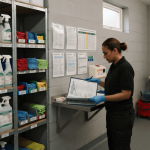
Many COSHH problems begin in the cleaning cupboard. The products may look familiar, but poor storage, weak labelling or accidental mixing can create serious risk. Managers should look beyond the label and check how chemicals interact in real working conditions.

  • Spraying cleaners in large offices can leave droplets or aerosols in the air. This may irritate cleaners and affect occupants who enter the area later.
  • Heavy containers should sit on lower shelves to reduce the risk of drops, splashes and handling injuries.
  • Spill containment trays, often called bunds, can catch leaks before they reach floors, drains or other stored products.
  • Cupboards should stay at a suitable temperature. Excess heat can damage containers or increase pressure inside some products.
  • Bleach should never be mixed with ammonia-based products. The reaction can create toxic gas, so staff need clear instruction and good ventilation.

Procedures for Safe Cleaning Operations As Per COSHH

COSHH works best when it moves out of the folder and into the cleaner’s daily routine. A safe working procedure should tell staff, in plain terms, which product to use, how to dilute it, what PPE is required and the correct cleaning method for the task. For higher-risk jobs, simple laminated task cards can help more than long documents kept in an office drawer.

Dilution needs particular care. Cleaning staff should never use unmarked bottles, old drinks containers or guessed measurements. Each mixed product should carry a clear label, including the product name, strength and expiry date. Emergency steps should also be easy to find, especially for spills, splashes, fumes or accidental chemical mixing.

Good procedures should not sit unchanged for years. Review them after a new product, site change, near miss or staff concern.

Selecting Appropriate COSHH Protective Equipment

PPE has an important place in COSHH for cleaning chemicals, but it should not be the first answer to every risk. A business should first look at safer products, better dilution systems, good ventilation and clear work methods. PPE then acts as the last line of defence when contact, splashes or inhalation risk still remains.

The right protection depends on the chemical and the task. Nitrile gloves are often a better choice than latex for cleaning work because they resist many chemicals and reduce the risk of latex allergy. Even then, glove type, thickness and fit matter. Gloves that are too loose can let diluted cleaner run inside, which defeats the purpose.

Eye protection is just as important where splashes may occur, such as toilet cleaning, decanting concentrates or working above shoulder height. For some tasks, safety glasses may be enough; for stronger products, chemical goggles give better splash control.

Respiratory protective equipment needs more care. It only protects staff when the correct type is selected, fitted and worn as instructed. A loose mask gives false comfort, not real protection.

For cleaning teams, PPE must be available, comfortable to wear and understand its purpose. If staff find it awkward or unsuitable, they will not use it.

What Businesses Should Record During COSHH Training

COSHH training should not be treated as a one-off induction item. Cleaning staff need clear, site-specific instruction that matches the products they use, the rooms they clean and the risks they may face during a normal shift. A short practical session often works better than a long policy document that no one revisits.

Businesses should keep a simple record of who was trained, which cleaning chemicals were covered, what tasks were demonstrated and what PPE was explained. The record should also show the emergency steps taught for spills, splashes, fumes or accidental mixing. Add the training date, trainer name and any refresher needs, especially after a new product, site change, near miss or updated COSHH risk assessment.

A 2026 HSE Case Example

A 2026 HSE prosecution shows why chemical control cannot be treated as paperwork. A recent case occurred this year where two workers suffered serious caustic soda burns at separate Essex sites.

The company ultimately pleaded guilty to two charges of breaching Regulation 7(1) of the Control of Substances Hazardous to Health (COSHH) Regulations 2002. They were fined £3.8 million and ordered to pay £124,748 in costs at Southwark Crown Court.

COSHH Cleaning Compliance Checklist for 2026

A practical COSHH checklist helps UK businesses keep cleaning safety visible. It should give managers a clear view of what is controlled on site and what still needs attention.

  • Keep a full chemical inventory for every cleaning product on site. Small bottles stored in kitchens, washrooms and cleaning cupboards.
  • Record where each product is kept, what it is used for and which staff members are authorised to use it.
  • Keep the current Safety Data Sheet for each product close to the point of use, not buried in an old office folder.
  • Review COSHH risk assessments against the real cleaning task. Dilution, usage, storage, mixing and disposal.
  • Consider safer cleaning products before relying on gloves, masks or other PPE as the main control.
  • Use clear product labels on every container. This extends to diluted chemicals prepared for daily cleaning tasks.
  • Check that proper dilution controls are in place, in particular, for concentrated floor cleaners, washroom products and disinfectants.
  • Inspect cleaning cupboards for leaks, damaged packaging, poor ventilation and incompatible chemicals stored together.
  • Check that all cleaning products are labelled, diluted correctly and stored in suitable containers.
  • Make spill response and first-aid steps clear, visible and easy for staff to follow.
  • Select PPE by task and chemical risk, rather than handing out the same protection for every job.
  • Keep clear staff training records and refresher dates.

frequently asked questions

Yes. Eco-friendly cleaning chemicals can still be hazardous. Sustainable sourcing or biodegradability does not mean a product is risk-free, so businesses should still check the label, SDS and task risk.
COSHH is a set of regulations. A checklist is not the law itself, but it helps businesses track the steps needed to comply with COSHH duties in daily cleaning work.
In Great Britain, COSHH is enforced by the Health and Safety Executive and local authorities, depending on the workplace. In Northern Ireland, HSENI has responsibility for workplace health and safety enforcement.
COSHH does not apply to private household use. It can apply in residential buildings when work activities take place, such as paid cleaning, care services, landlord maintenance or contractor work.
A COSHH assessment should be reviewed when products, tasks, staff, equipment or site conditions change. It should also be checked after a near miss, incident or staff concern.

Recent Posts

Infection Control Cleaning in the Workplace: Standards, Protocols and Best Practice

Cleaning Challenges Facing Wolverhampton Businesses and How to Solve Them

Retail Cleaning Checklist for Shops and Shopping Centres

Commercial Cleaning Services in Birmingham and the UK: The Complete Guide

Workplace Cleaning, Health & Safety Law: What Every UK Employer Must Comply With

COSHH in Commercial Cleaning What UK Businesses Must Know

What Should Be a Commercial Cleaning Specification? A Procurement Guide

Pricing Model for Commercial Cleaning in the UK? Complete 2026 Pricing Breakdown

Request a Quote