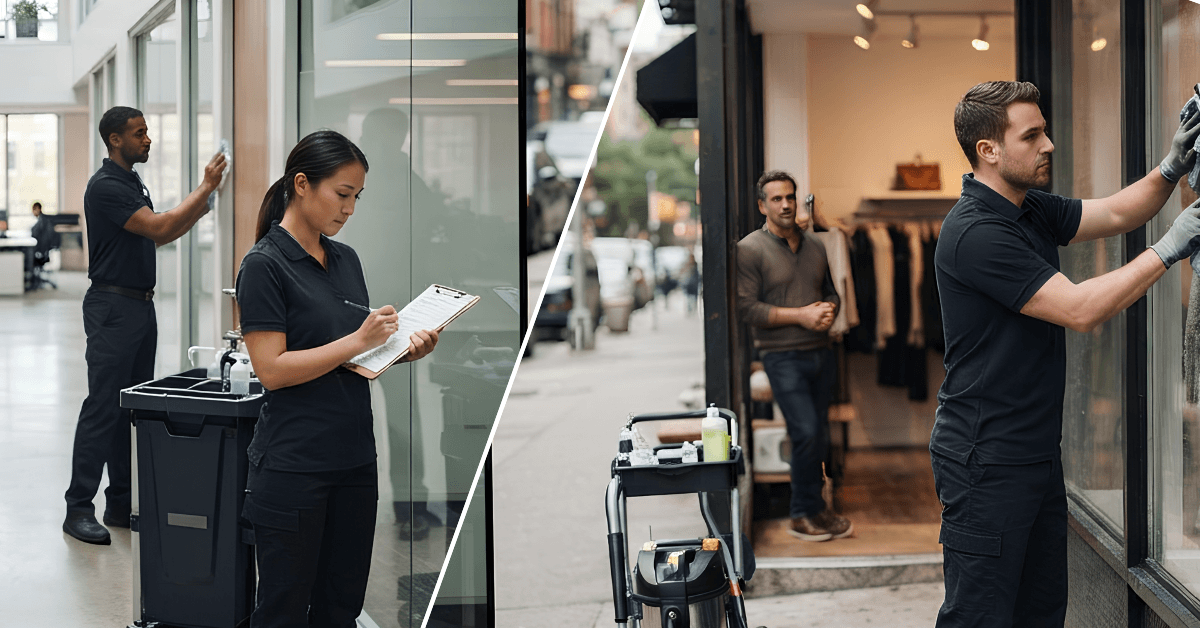
When outsourcing cleaning, premises managers often face a bit of a muddle. Whilst commercial and contract cleaning sound like the same thing, they have slightly different remits.
Commercial cleaning service is the actual work being carried out, whereas contract cleaning is the ongoing legal agreement to manage it when outsourcing a project.
This blog will clarify everything you need to know regarding how both differ.
Professional cleaning is tailored for organisations, rather than residential homes.
It requires commercial-grade equipment and focuses on strict health and safety compliance, high-traffic areas and operational hygiene.
In fact, the term “commercial cleaning” isn’t just about outsourcing; it applies to any in-house cleaning duties carried out within commercial premises.
Who it serves: Offices, warehouses, retail stores, schools and healthcare facilities.
The legally binding framework is used to outsource and manage your commercial cleaning needs.
It outlines what the cleaners will do, when they will do it and what standards must be met.
What it covers:
Outsourcing via a commercial cleaning contract allows businesses to maintain strict workplace hygiene without worrying about day-to-day staff management.
For a spot of further reading, do take a gander at our blog: A Guide on Commercial Cleaning Contract.
Here is the detailed breakdown of the difference between commercial cleaning and contract cleaning Service.
| SR. NO. | Feature | Commercial Cleaning | Contract Cleaning |
|---|---|---|---|
| 1 | Definition | A broad term covering any cleaning of business premises (offices, retail, factories), which can be handled by in-house teams or specialist third-party providers. | A formal agreement to outsource cleaning to a professional agency on a recurring schedule in exchange for a set of fees. |
| 2 | Arrangement | Can be structured as one-off services, ad-hoc deep cleans or managed via internal employee rotas and equipment purchases. | Managed under a negotiated Service Level Agreement (SLA) that outlines frequency, tasks and KPIs when strictly outsourcing. |
| 3 | Responsibility | If in-house, the business must buy equipment, hire/train staff and cover HR/sick leave. If a third party depends on the one-off project scope. | The cleaning provider assumes full responsibility for staff management, equipment, COSHH compliance and providing cover when regular cleaners are absent. |

Not all cleaning services are delivered the same way. A professional office cleaning service can be tailored to your schedule, cleaning standards and workplace requirements, whether you need routine maintenance or a comprehensive cleaning contract.
If the difference is a service model versus a service category, why is there so much confusion?
Overlap happens due to industry terminology. Many service providers use “commercial cleaning” as their primary marketing term to attract B2B clients, even if 90% of what they do is contract cleaning. Furthermore, procurement teams often speak in terms of “contracts” (the agreement), whilst operational teams speak in terms of “commercial” (the environment).
When outsourcing cleaning, premises managers often face a…
Most office cleaning routines focus on what you…
Managing cleaning contracts requires careful planning. Before a…
Commercial cleaning companies in the West Midlands charge…
Long before anyone speaks up, your office signals…
Did you know that office desks can contain…
As you manage multiple or single business premises,…
Hotel success rests on a foundation of guest…