Cleaning Challenges Facing Wolverhampton Businesses and How to Solve Them
Wolverhampton is one of the UK’s most economically active cities outside London. Its manufacturing corridor, one million square feet of retail space, a fast-growing logistics sector and a business services community employing nearly one in five of the city’s workers all generate a common, often underestimated operational challenge: keeping commercial premises consistently clean, safe and compliant.
For many Wolverhampton businesses, cleaning is managed reactively, addressed when a problem becomes visible rather than before it does. That approach is costly. It erodes staff wellbeing, undermines customer confidence and, in regulated environments, creates compliance exposure that carries real financial consequences.
This guide covers the specific cleaning challenges most commonly reported by businesses across Wolverhampton and the practical, proven solutions that resolve them.
Wolverhampton's Industrial Past Leaves Its Mark on Commercial Premises
Wolverhampton has deep roots in iron, steel and motor manufacturing. Many of the commercial and industrial buildings in active use today were built for a different era, meaning older ventilation systems, porous flooring materials, hard-to-reach high-level surfaces and layouts that were never designed with modern hygiene standards in mind.
Businesses operating from these premises frequently encounter:
Accumulated grime in hard-to-access areas such as ducting, ceiling beams, high-level storage and mezzanine structures that collect grease, dust and particulate matter that standard cleaning rotations never reach
Porous concrete and brick surfaces that absorb spillages and harbour bacteria if not treated with the right methods and products
Legacy drainage and washroom infrastructure that requires more rigorous hygiene protocols than newer installations
The solution is not a standard office cleaning contract. These environments need a specialist who understands the difference between surface cleaning and deep decontamination and who schedules high-level and periodic deep cleans alongside routine maintenance cleaning to keep all areas genuinely hygienic, not just presentable.
Challenge 1: Offices and Business Premises That Clean Up to Appearance, Not Standard
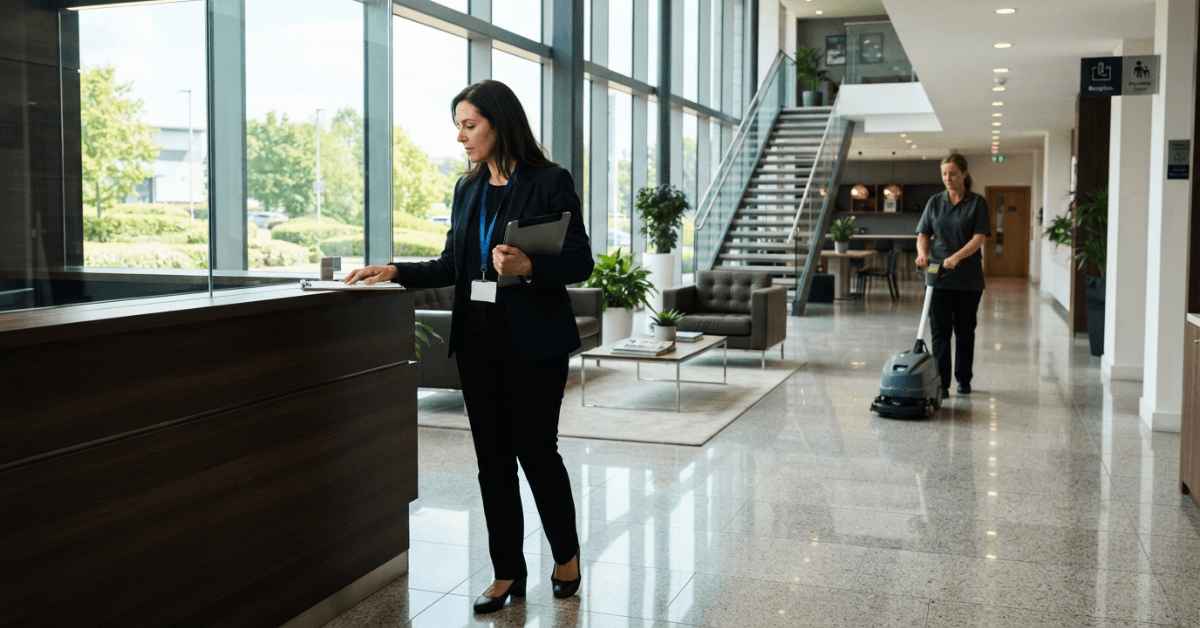
Wolverhampton’s business services sector employs around 20,000 people across offices, professional services firms, financial institutions and administrative operations. Most of these workplaces receive daily or weekly cleaning but a significant number are cleaned to a visual standard rather than a hygiene standard.
Wiped-down desks and empty bins look clean. They are not the same as a workspace with low bacterial load, clean air and sanitised high-touch surfaces. The distinction matters more than many managers appreciate: poor indoor air quality and inadequate surface disinfection are among the most significant drivers of staff illness, absenteeism and reduced concentration.
Common office cleaning failures in Wolverhampton:
Keyboards, phones, door handles and light switches touched dozens of times daily but cleaned infrequently or not at all
Kitchens and breakout areas cleaned only at the end of the day, leaving contaminated surfaces in active use for hours
Carpets and upholstered seating vacuumed but not deep-cleaned, accumulating allergens and bacteria over months
Air handling units and partition tops ignored entirely, circulating dust and particulates throughout the office
The solution: A properly structured commercial office cleaning service covers high-touch surface sanitisation as a daily non-negotiable, not an optional extra. Schedules should distinguish between daily maintenance tasks and weekly or periodic deep-clean tasks. A COSHH-compliant cleaning plan should also specify the correct products for each surface type, not a single multipurpose spray applied to everything.
Challenge 2: Wolverhampton's Retail Sector and the Hygiene Gap Behind High Footfall
Wolverhampton’s city centre is home to over one million square feet of retail space generating £535 million annually, making retail one of the most commercially significant sectors in the city. The Mander Centre, Wulfrun Centre and the broader high street collectively serve tens of thousands of shoppers each week.
High footfall creates a cleaning challenge that is genuinely different in scale and character from an office environment. Entrances and exits accumulate mud, water and debris within minutes of a clean. High-touch points such as escalator handrails, lift buttons, fitting room door handles and till areas are contaminated and recontaminated throughout the day. Food court areas require grease management, not just surface wiping.
The problem most Wolverhampton retailers face is not the absence of cleaning. It is the absence of cleaning that is timed, sequenced and resourced to match the actual rhythm of footfall.
What a well-structured retail cleaning operation looks like:
Entrance and high-traffic zone check at agreed intervals during trading hours, not a single clean before opening
Washroom refresh visits timed against peak footfall periods, not fixed-interval clocks that ignore how a facility is actually being used
End-of-trading deep clean of food preparation and service areas that goes beyond wiping down and addresses grease, biological contamination and drainage hygiene
Window and glass cleaning on a schedule that maintains the presentation standard customers use to judge the business before they enter
Our retail cleaning services are built around trading hours and footfall patterns, not generic cleaning schedules applied uniformly regardless of how a premises actually operates.
Challenge 3: Warehousing and Logistics (Wolverhampton's Fastest-Growing Sector)
Transportation and storage is Wolverhampton’s fastest-growing industry, with employment in the sector increasing by 60% in a single year. Pendeford Business Park, Wolverhampton Business Park and the surrounding logistics corridors house distribution centres, storage facilities and freight operations that run around the clock.
Industrial and warehouse environments present cleaning challenges that no standard commercial contract is designed to handle:
Loading bay and dock areas exposed to vehicle exhaust, hydraulic fluid, road grime and heavy foot and forklift traffic that requires industrial-grade degreasers, not domestic cleaning products
Racking systems and mezzanine floors that accumulate dust, broken packaging, pallet debris and pest attractants if not cleaned on a structured schedule
Welfare facilities under heavy use including canteens, washrooms and locker rooms used by shift workers on tight break schedules, requiring frequent refresh visits throughout a 24-hour operation
Spillage response from lubricants, packaging materials, food products or chemicals that requires correct COSHH-compliant treatment, not a general mop-up
Concrete and resin flooring that requires machine scrubbing rather than mop-and-bucket cleaning to maintain surface integrity and anti-slip performance
Our industrial and warehouse cleaning services are structured specifically for these environments with industrial scrubber-dryer equipment, trained operatives and scheduling built around shift patterns and production cycles rather than standard office hours.
Challenge 4: Communal Areas That Become the Weakest Link in a Professional Building
Many of Wolverhampton’s commercial buildings, including mixed-use office blocks, business centres, serviced offices and apartment buildings with commercial ground-floor units, share communal infrastructure such as lobbies, lifts, stairwells, shared washrooms, car park access points and bin store areas.
These spaces are used by everyone and owned, in a facilities sense, by no one in particular. The result is a well-documented pattern: individual tenants maintain their own spaces to a reasonable standard while communal areas quietly deteriorate. Lifts accumulate grime in door channels and on control panels. Stairwells collect litter, dust and biological contamination. Bin stores become a hygiene and pest risk.
The problem is compounded when communal area cleaning responsibility is split across multiple managing agents, landlords and individual occupiers, each assuming someone else is handling it.
A dedicated communal area cleaning contract with clearly defined responsibilities, documented visit logs and a single point of accountability removes this ambiguity. For Wolverhampton building managers, it is also increasingly relevant to lease renewal and RICS compliance. Inspectors and prospective tenants assess shared spaces as part of their due diligence.
Challenge 5: Manufacturing Sites and Why Industrial Cleaning Is Not the Same as Industrial-Scale Cleaning
Advanced manufacturing companies based in Wolverhampton’s aerospace and automotive hub generate a combined revenue of £650 million. These operations, alongside food production facilities, engineering workshops and materials processing sites, face cleaning requirements that are as operationally complex as any aspect of the production process itself.
The risks are specific:
Cross-contamination in food-grade environments where inadequate cleaning protocols between production runs create allergen contamination risk, bacterial growth risk and serious regulatory exposure under Food Standards Agency guidelines
Metal swarf, oil and coolant contamination in engineering and CNC machining environments that creates both slip hazard and fire risk if not removed on an appropriate schedule
Dust and particulate management in materials processing which affects air quality, equipment performance and, in some substrates, creates explosive atmosphere risk in ATEX environments
Chemical storage area hygiene where cleaning requires operatives with COSHH awareness, correct PPE selection and proper waste disposal protocols
These are not scenarios where a general commercial cleaning company with standard equipment and products can deliver appropriate results. They require trained operatives, industry-specific methodology and documented compliance records.
Challenge 6: Windows and External
Wolverhampton’s commercial high streets, business parks and mixed-use developments all face the same recurring issue: external building presentation deteriorates gradually and is noticed only when it becomes embarrassing.
Dirty or streaked windows, grimy entrance canopies, moss and algae on external cladding and water-stained signage are not merely aesthetic problems. For any business that depends on walk-in trade, client visits or professional reputation, the external presentation of the building is the first credibility signal a visitor receives. Solicitors, accountants, estate agents, dental practices and hotels are all judged before a customer even reaches the door.
The challenge in Wolverhampton is compounded by the West Midlands climate. Rain, wind and urban particulate pollution combine to soil exterior glass quickly, and high-level windows on multi-storey premises are out of reach for standard cleaning methods.
Our professional window cleaning service covers ground-level and high-level external glazing using reach-and-wash pole systems and, where required, abseiling or MEWP access, maintaining the external presentation standard that client-facing businesses in Wolverhampton cannot afford to let slip.
Challenge 7: Staff Turnover in In-House Cleaning Roles Creates an Invisible Risk
Many Wolverhampton businesses employ cleaning staff directly rather than contracting a specialist provider. On paper this appears cost-effective. In practice it creates a set of operational vulnerabilities that facilities managers frequently underestimate until something goes wrong:
High turnover with cleaning roles filled in-house consistently seeing above-average staff churn, meaning investment in induction and training is repeatedly lost
No cover for absence meaning that when an in-house cleaner calls in sick, the cleaning simply does not happen unless a manager arranges emergency cover
Inconsistent standards where without systematic quality management, performance naturally varies between individuals and between visits
Compliance gaps as COSHH regulations, RIDDOR requirements for cleaning-related accidents and waste disposal legislation apply equally to in-house staff but the compliance burden falls on the employer without the specialist infrastructure a contracted provider brings
Equipment and product costs where professional cleaning machinery such as scrubber-dryers, steam cleaners and extraction equipment represents capital expenditure that in-house operations frequently defer, reducing cleaning quality over time
Contracting a specialist provider transfers these operational and compliance responsibilities to an organisation built to manage them. The total cost, when properly calculated to include employment on-costs, equipment, products, management time and compliance overhead, is typically comparable to or lower than a like-for-like in-house operation.
The Wolverhampton-Specific Factor: Mixed Business Density and Variable Premises Age
What makes Wolverhampton genuinely distinct as a commercial cleaning environment is the density and variety of business premises within a relatively compact geography. A single street in the city centre or on a business park might contain Victorian-era industrial buildings converted to office use, purpose-built 1990s distribution units, modern glass-fronted commercial premises and everything in between.
Each building type has different cleaning requirements, different access challenges and different product and equipment needs. A cleaning company that can genuinely serve the range of Wolverhampton businesses, from the aerospace component producers in the north of the city to the retail operators in the Mander Centre and the professional services firms around Wolverhampton station, needs to operate across multiple disciplines with demonstrable experience in each.
How Innovative Cleaning Serves Wolverhampton Businesses
Innovative Cleaning provides commercial cleaning services to businesses across Wolverhampton and the wider West Midlands from our Birmingham base. Our Wolverhampton cleaning services cover:
Offices and professional services premises
Retail and customer-facing commercial spaces
Industrial units, warehouses and logistics facilities
Communal areas in managed commercial and residential buildings
Windows and external building presentation
Specialist periodic and deep cleaning
All operatives are DBS-checked, COSHH-trained and inducted to site-specific requirements. We work to BICSc cleaning standards and hold CHAS accreditation, providing documented evidence of compliance for businesses that need it for audit or regulatory purposes.
Cleaning schedules are built around your operating hours and specific business requirements, not a standard template. We provide a single point of contact, regular quality inspections and documented visit logs for every service.
For a no-obligation cleaning assessment of your Wolverhampton premises, contact Innovative Cleaning on 0808 280 2662 or email info@innovativecleaning.co.uk.
Yes. Innovative Cleaning serves businesses across the whole of Wolverhampton including the city centre, Bilston, Wednesfield, Pendeford, Coven Heath, Fallings Park and the surrounding business parks and industrial corridors.
Yes. We schedule all cleaning around your operating hours including early morning, evening and weekend visits. For 24-hour operations such as warehouses and logistics facilities, we work around shift patterns and production cycles.
Yes. We provide both regular contracted cleaning on daily, weekly or bespoke schedules and one-off or periodic deep cleans. Many clients use both, with a regular maintenance contract supplemented by quarterly deep cleans of specific areas.
All Innovative Cleaning operatives are DBS-checked and trained to BICSc standards. We hold CHAS accreditation and operate COSHH-compliant cleaning plans on all sites. Compliance documentation is available on request.
For most commercial premises, we can mobilise a new cleaning contract within five to seven working days of a site assessment and contract agreement. Emergency or short-notice requirements can often be accommodated faster. Contact us to discuss your timeline.
We do not impose rigid long-term contract minimums. Contract terms are agreed based on the nature of your requirements. We focus on earning retention through service quality rather than contractual lock-in.